

A Confrontation at Makar Dwar
The incident unfolded near the Makar Dwar, where Congress lawmakers had gathered to protest the suspension of eight of their colleagues. The MPs were penalized on Tuesday for "unruly behavior" after a heated standoff regarding an unpublished memoir by a former Army Chief and a controversial India-US trade agreement.
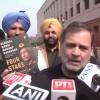
As Ravneet Singh Bittu, the Minister of State for Railways, walked past the demonstration, the atmosphere turned electric. Gandhi, pointing toward his former party colleague, reportedly remarked to the surrounding crowd, "Here is a traitor walking right by. Look at the face."
In a moment of high-stakes political theater, Gandhi extended his hand toward Bittu, sarcastically offering a handshake. "Hello brother, my traitor friend," Gandhi said, according to witnesses. "Don't worry, you will come back [to Congress]."
Rejection and Retort
The gesture was met with immediate hostility. Bittu, who defected from the Congress to the Bharatiya Janata Party (BJP) in March 2024, refused to take Gandhi’s hand. Instead, he fired back with a stinging rebuke, labeling the Leader of Opposition a "desh ke dushman" (enemy of the nation).
The verbal spat reflects a long-standing animosity between the two. Since his defection, Bittu has been a vocal critic of the Gandhi family, while the Congress has frequently characterized his move to the BJP as an act of political opportunism.
Policy at the Heart of the Protest
Beyond the personal barbs, the protest was fueled by significant policy grievances. The Opposition has accused the Prime Minister of being "compromised" on foreign policy, specifically targeting the recently announced India-US trade deal.
Rahul Gandhi has alleged that the agreement:
-
Harms Indian Farmers: Claims suggest the deal "sells out" the interests of domestic agricultural workers.
-
Lacks Transparency: The Opposition has questioned the timing of the deal, which Gandhi alleges was signed under "enormous pressure" from Washington.
-
Suppresses National Security Debates: The protests also stem from Gandhi being blocked from quoting excerpts of a memoir that allegedly details leadership indecision during the 2020 border standoff with China.
"The issue is not just a statement; the main thing is that our Prime Minister has been compromised," Gandhi told reporters earlier, linking the trade deal to external legal pressures.
Broader Implications
The confrontation is more than just a localized spat; it signals a total breakdown in parliamentary decorum. With eight MPs suspended for the remainder of the session, the government’s ability to conduct legislative business without constant disruption remains in doubt. As both sides retreat into increasingly polarized rhetoric—with terms like "traitor" and "enemy" becoming commonplace—the prospect of a constructive legislative dialogue during this Budget Session appears increasingly remote.
About The Author






Comment List